# Moshup
Dive into the the legend of Wampanoag folklore hero, Moshup, in his whale form with artist Andromeda Lisle's public art mural! Painted with an array of blues and greens in Lisle's colorful style, this mural of Moshup aims to highlight the importance of preserving the cultural significance of animals in the Americas as well as the Indigenous stories that surround them.
*Moshup* was on display outside the Harvard Ed Portal April 25, 2022–March 27, 2023. You can now view it at the [Peabody Museum](https://peabody.harvard.edu/home) April 3–17, 2023.
### **Go to:**
- [Mythology of Moshup](#mythology)
- [Behind the Scenes](#behind-the-scenes)
- [Meet the Artist](#meet-artist)
- [Dive Deeper](#dive-deeper)
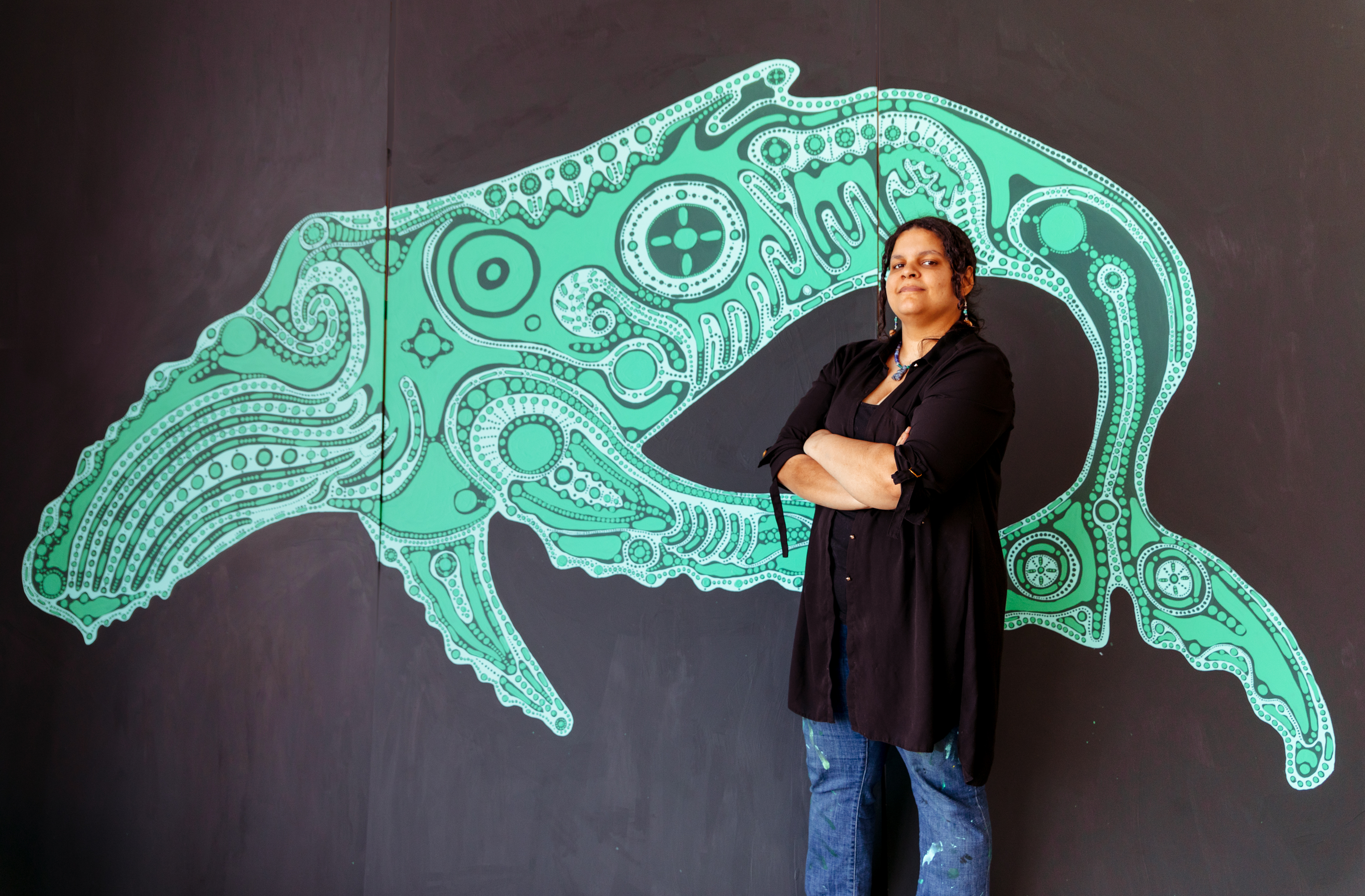
##### *Muralist Andromeda Lisle with her painting in-progress. Photo by Mel Taing (Instagram: [@m.ltaing)](https://www.instagram.com/m.ltaing/)*
## A Whale of a Tale: Mythology of Moshup
Moshup is not a name many would recognize, nor his story and relevance to the very land they stand upon. A cultural folklore hero to the Wampanoag and nearby coastal tribes, Moshup was a benevolent giant that lived peacefully with the first peoples. In particular Moshup was important to the Wampanoag of Noepe (Martha's Vineyard), as he helped shape the land itself of Noepe, Nantucket, and other features of Cape Cod.
Moshup wanted the humans he lived alongside to thrive, and so taught them many skills related to the sea. Most important was his knowledge on whales, of which he knew everything about and could even transform into on a whim. Often he would pluck whales from the sea to give directly to the tribes as gifts, laying them on the beach to be utilized for a myriad of important purposes. When Moshup decided he had taught all he could, it was said he transformed into a great white whale and disappeared into the ocean for a final time, secure that his teachings would see the first peoples through.
*Stan Murphy's mural of Native American folklore hero, Moshup, in Martha’s Vineyard.*
Color-in-Art Download, print, and color your own mural of Moshup!
[Download & Print](/file_url/1325)
*Recommended printer settings: Landscape orientation*
##### *Photo by Mel Taing (Instagram: [@m.ltaing](https://www.instagram.com/m.ltaing/))*
#### [Visit Andromeda Lisle's Website](https://www.theandromedagallery.net/)
## Andromeda Lisle
Andromeda Lisle is a multi-medium artist residing in Cambridge, MA since childhood. Brought up by her mother with their rich mixed-heritage of Black, Native, and Irish, Andromeda grew up with a great love of story and the natural world. By the time she received her BS in Fine Art from Skidmore College, most of Andromeda's art focused on animals in myth and legend, mainly those from her Indigenous heritage. Now it is her drive and passion, with preservation and education of the cultural significance of animals in the Americas on the forefront of her mind.
Open all sections Close all sections
### Read More expand\_more
Andromeda's works are comprised of her deeply personal beliefs which have shaped her adult life. Two key concepts have come together to drive most of her work: the beliefs, stories, and legends that shaped the human race for millennia, and her own eclectic identity as a multi-racial and disabled woman growing and learning through her connection to her diverse heritage.
Andromeda's fascination with the figures and feelings of ancient stories led her to dive into those of her unique ancestry, with Native American, African, and Celtic stories and beliefs capturing her heart the most. The tales and figures of Native Americans drew her in the most powerfully, and she could not bear for them to be forgotten or ignored in the very lands they originate from. She feels a deep drive to preserve the spiritual and cultural importance of animals and the natural world of the Americas at large, and hopes to bring attention to them through her art.
*Andromeda Lisle has also written and illustrated, [Spirits of America](https://www.theandromedagallery.net/product-page/spirits-of-america), a passion project that aims to preserve and educate about American Indigenous animal spirit lore. These stories and knowledge have ever been in danger of becoming lost or inaccessible, scattered like their peoples due to the systematic destruction of both. Making them easy to find and learn about for all ages will help them persevere, and hopefully become as prevalent in American culture as Eurocentric myths and lore.*
## Dive Deeper
Whether you want to explore the ocean depths or you're looking for classroom resources, we've compiled information about whales, the Wampanoag tribe, local museums and attractions, and fun activities for all!
Whales [Project CETI](https://www.projectceti.org/) is applying advanced machine learning and gentle robotics to decipher the communication of one of the world's most enigmatic ocean species: the sperm whale.
This nonprofit grew out of a series of meetings among scholars from various fields that began at the [Radcliffe Institute for Advanced Study](/https:/www.radcliffe.harvard.edu/) in 2017. The researchers—a collection of biologists, cryptographers, linguistics, computer scientists, and robotics experts—will begin by gathering the whales' sounds and observing their patterns of behavior. In their final phase, they hope to play taped vocalizations back to the animals and record how they respond.
Wampanoag Tribe For over ten thousand years the Wampanoag have inhabited the island of Noepe (Martha's Vineyard), and once encompassed over 67 distinct tribal communities across Southeastern Massachusetts and Eastern Rhode Island. Their deep history, legends, and customs continue to be preserved by tribe members—including land and resource management, traditional arts, and the Wampanoag language—and their influence is felt island-wide.
Today, Wampanoag environmental practices and values still help inform and maintain the island's beauty; island roads follow paths once worn smooth by their ancestors; and Wampanoag place names pay homage to the earth's bounty.
Local Attractions Explore the rich history and culture of the Wampanoag at several local museums and historical parks! You'll learn about the practice of drift-whaling, discover ancient artifacts and heirlooms, view dioramas that depict typical scenes of an early Wampanoag settlement, and uncover the history of the lands where tribes have lived for centuries.
- **[Mashpee Wampanoag Museum](https://mashpeewampanoagtribe-nsn.gov/museum)**
- **[Plimoth Patuxet Museums](https://plimoth.org/plan-your-visit/explore-our-sites)**
- **[New Bedford Whaling National Historical Park](https://www.nps.gov/nebe/learn/historyculture/nativeamerican.htm)**
Activities for Youth Learn about the Wampanoag's history and culture with these family-friendly resources!
- Travel to back to Wampanoag Patuxet and colonial Plymouth to [uncover the story of the first Thanksgiving](https://plimoth.org/for-students/you-are-the-historian). Magical time travel, mysterious riddles, and artifacts are just ahead!
- View [historic cooking recipes](https://plimoth.org/for-students/activities-games/historic-cooking) from Plimonth Patuxet, test your wit with [17th-century riddles](https://plimoth.org/for-students/activities-games/riddles), and other activities!
- Learn about the [Wampanoag way of growing food](https://plimoth.org/for-students/homework-help/growing-food); differences between [English and Wampanoag dwellings](https://plimoth.org/for-students/homework-help/building-a-home); how Wampanoag children [played and learned](https://plimoth.org/for-students/homework-help/playing-and-learning); and [much more](https://plimoth.org/for-students/homework-help)!
The Wampanoag were there when the Pilgrims arrived in 1620 and they are still there today. Learn about their lives long ago by meeting two modern-day Wampanoag girls.